
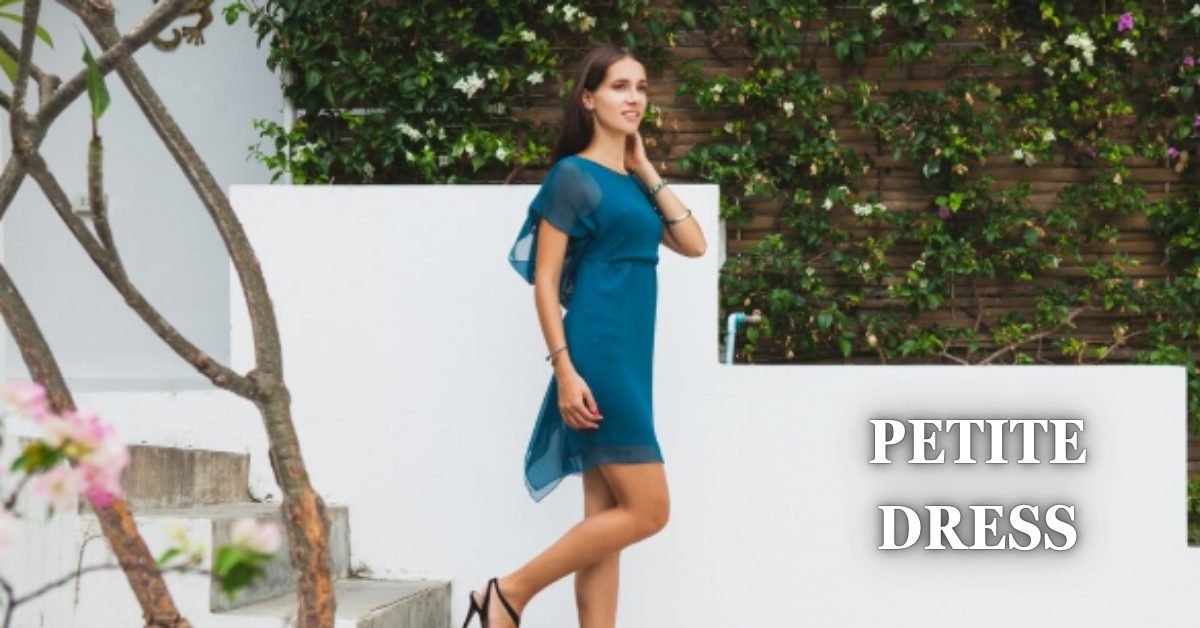
A petite dress is built on different proportions than a regular dress, not just a smaller number on the tag. The waist seam sits higher, the sleeves and bodice are shortened, and the hem is cut to land where a frame of 5’4″ or under actually breaks. Most fit complaints, a hem that drags mid-calf or a waistline that hits somewhere near the hip, trace back to buying a regular dress in a smaller size instead of an actual petite cut. This guide walks through the silhouettes, necklines, and hem lengths that work, plus the one mistake that quietly ruins most petite dress purchases. By the end, you will know exactly what to check before adding a dress to your cart.
Short Answer
A petite dress is proportioned for women 5’4″ and under, with a raised waist seam, shortened sleeves, and a hem calibrated to a shorter torso and leg length. It is not simply a regular dress sized down. Buying by proportion, not just by size, is what makes the difference.
What “Petite” Actually Means on a Dress Label
The word petite gets used loosely, but in dress sizing it refers to a specific proportion system, not a body type or a weight class. A brand’s petite line adjusts where the waist seam sits, how long the sleeves run, and how much fabric hangs below the knee, all scaled for a shorter torso and leg length rather than just a smaller bust and hip measurement. Two women can share the same bust size and still need entirely different dress cuts if one of them is 5’2″ and the other is 5’7″.
This distinction has a real history behind it. Petite sizing in American fashion traces back to the 1940s, when designer Hannah Troy studied the measurements of women who had served in the military during World War II and found that most of them were proportioned differently through the waist than standard sizing assumed, according to the Wikipedia entry on petite sizing. That early research is the reason petite dresses still adjust waist placement first, since a dropped or overly long torso is usually what makes a regular dress look wrong on a shorter frame, even when the bust and hip numbers line up fine.
The Silhouettes That Actually Work at 5’4″ and Under
A-line dresses tend to be the safest starting point because the flare begins at a defined waist and moves outward in one continuous line, which reads as height rather than bulk. Look for one that flares from the natural waist rather than from higher up near the bust, since an empire-style flare on a petite frame can visually shorten the torso even more. Wrap dresses work for a similar reason, the diagonal wrap line draws the eye up and across rather than straight down, and the self-tie waist naturally sits at the narrowest point of the body instead of wherever the pattern happened to land.
Sheath and shift dresses are the harder silhouettes to get right, because there is no seam or flare to hide a length problem. A sheath cut for a petite frame usually runs about two to three inches shorter overall than the standard version, with the waist dart placed higher, so the whole dress reads as one clean vertical line instead of a column that swallows the legs. Fit-and-flare dresses can work beautifully too, but the flare should start at or slightly above the natural waist. A flare that starts at the hip on a petite body tends to add width right where the torso is already running short, which fights the proportion instead of helping it.
Necklines and Sleeves That Don’t Overwhelm a Shorter Frame
Necklines carry more weight on a petite dress than most shoppers expect, since a wide or heavily embellished neckline can visually shorten the torso before the eye even reaches the waistline. A V-neck or a scoop neck creates a vertical line that draws the eye down toward the waist, which is exactly the effect a petite frame benefits from. Square necklines do something similar, and they tend to photograph as polished without needing much else going on, the same principle that comes up when choosing a square neck top that doesn’t gap or slide for a shorter torso.
Sleeve length matters just as much, even though it gets far less attention in most buying guides. A sleeve cut for an average 5’6″ arm will bunch at the wrist on a shorter arm, which reads as sloppy no matter how well the rest of the dress fits. Elbow-length and three-quarter sleeves are usually the safest bet on a petite dress, since full-length sleeves are the ones most likely to need shortening, and cap sleeves or sleeveless styles sidestep the issue completely.
Getting the Hem Length Right
Hem placement is where most petite dress purchases actually go wrong, more than fabric or color ever do. A dress that lands mid-calf on a taller frame will often hit closer to the ankle on someone 5’2″, which visually cuts the leg line and makes the whole outfit look longer and heavier than intended. The general rule that works across most petite frames is to keep hems either just above the knee or at a true midi length that ends a few inches below the knee, avoiding the awkward zone in between that cuts across the widest part of the calf.
If a dress is otherwise right but the length is off by an inch or two, hemming is almost always worth it rather than sizing down and losing room through the shoulders or hips. A local tailor typically charges somewhere between fifteen and twenty five dollars to shorten a hem and take in shoulder seams, which is frequently less than the price difference between a regular-cut dress and a genuine petite line from the same brand. That makes tailoring a fairly efficient way to get proportions right on a dress that fits everywhere else.
Where the Petite Dress Search Usually Goes Wrong
The most common mistake is not the silhouette or the color, it’s assuming that ordering the smallest available size solves a petite fit problem. Sizing down shrinks the bust, waist, and hip measurements evenly, but it does nothing to move the waist seam up or shorten the distance between the shoulder and the hem. The result is a dress that fits snugly through the body while still hanging several inches too long, which is the exact complaint most petite shoppers describe when they say a dress “almost worked.”
This confusion happens because petite sizing and small sizing solve two different problems that sound similar on the surface. Small sizing addresses circumference, how much fabric wraps around the body. Petite sizing addresses length and placement, where the seams land vertically on a shorter frame. A woman who is 5’2″ and a size 12 needs petite proportions just as much as a woman who is 5’2″ and a size 2, since the issue is height, not dress size. Checking a brand’s actual petite size chart, rather than assuming the smallest size on the rack will do the job, is the single habit that fixes this.
Choosing a Petite Dress by Occasion
For work, a petite sheath or a wrap dress in a mid-weight fabric like ponte knit or a cotton-blend twill holds its shape through a full day without wrinkling as easily as pure cotton or rayon does. Pairing it with a cropped blazer, one that ends right at the natural waist rather than the hip, keeps the proportions balanced instead of adding another layer of length on top of an already-short torso.
For a casual daytime look, a shirred or elastic-waist dress in a lighter fabric gives more room to move without losing shape, and this is where color choice starts to matter as much as cut. A warm-toned red or rust reads well on most skin tones and photographs richly in daylight, though getting the exact shade right takes some of the same care as finding the right shade of red for a sundress, since a shade that leans too orange or too pink can throw off the whole look regardless of how well the dress fits.
For evening or formal occasions, a slip dress or a fitted midi in satin or a heavier crepe tends to outperform anything with excess volume, since draping fabric photographs as elegant on a petite frame in a way that gathered or ruffled fabric usually does not. A single vertical seam down the front, sometimes called a princess seam, does a lot of quiet work here, lengthening the line of the body without needing a belt or any added structure.
Fabric Weight and Price Tiers
Fabric weight affects a petite dress more than it affects a regular one, because there is less body length for heavy or stiff fabric to drape across before it starts to overwhelm the frame. Lightweight jersey, crepe, and fine-gauge knits tend to move with a shorter frame instead of adding visual bulk, while structured fabrics like heavy denim or thick brocade can read as costume-like on a petite body unless the cut is genuinely simple.
Budget petite dresses in the fifteen to forty dollar range, the kind found at mass retailers, are usually fine for casual wear but rarely include true petite engineering, meaning the length gets chopped down from a regular pattern rather than re-proportioned at the waist and shoulders. Mid-range options between forty and one hundred dollars, from brands with dedicated petite lines, more often include that re-proportioning, which is where the fit difference actually shows. Above one hundred dollars, the gain tends to be fabric quality and finishing rather than a meaningfully better fit, so a mid-range dress with twenty dollars spent on tailoring frequently outperforms a pricier dress that was never proportioned correctly to begin with.
Conclusion
The dress that actually works for a petite frame is the one built on the right proportions, not just the smallest size on the rack. Start with the waist seam and hem length before worrying about trend or color, since those two details decide whether everything else about the dress reads as intentional. Next time you’re shopping, check the brand’s petite size chart directly instead of guessing from the regular sizing, and keep a tailor’s number handy for the dresses that are close but not quite there.
FAQ
What height is actually considered petite for dress sizing?
Most brands define petite as 5’4″ and under, though a few set the cutoff at 5’3″ or 5’5″, so it’s worth checking the specific brand’s size chart rather than assuming a single universal cutoff.
Can a petite woman wear a maxi dress?
Yes, as long as the dress is either a true petite-cut maxi or gets hemmed, since an unaltered regular maxi will typically pool on the floor and needs one to three inches removed to sit correctly.
Is petite sizing the same as ordering a small?
No, small sizing only reduces circumference through the bust, waist, and hip, while petite sizing repositions the waist seam and shortens the overall length, which is why a petite woman can need a petite dress in any size, not just the smallest one.
Do petite dresses always need tailoring even after buying petite?
Not always, but shoulder width and sleeve length are the two spots most likely to still need a small adjustment even in a true petite cut, since petite sizing is based on average proportions and individual torsos vary.
Why do some brands’ petite dresses fit differently from others?
Petite sizing isn’t standardized across the industry, so each brand builds its own proportion formula, which is why a petite 4 from one label can fit noticeably differently than a petite 4 from another.