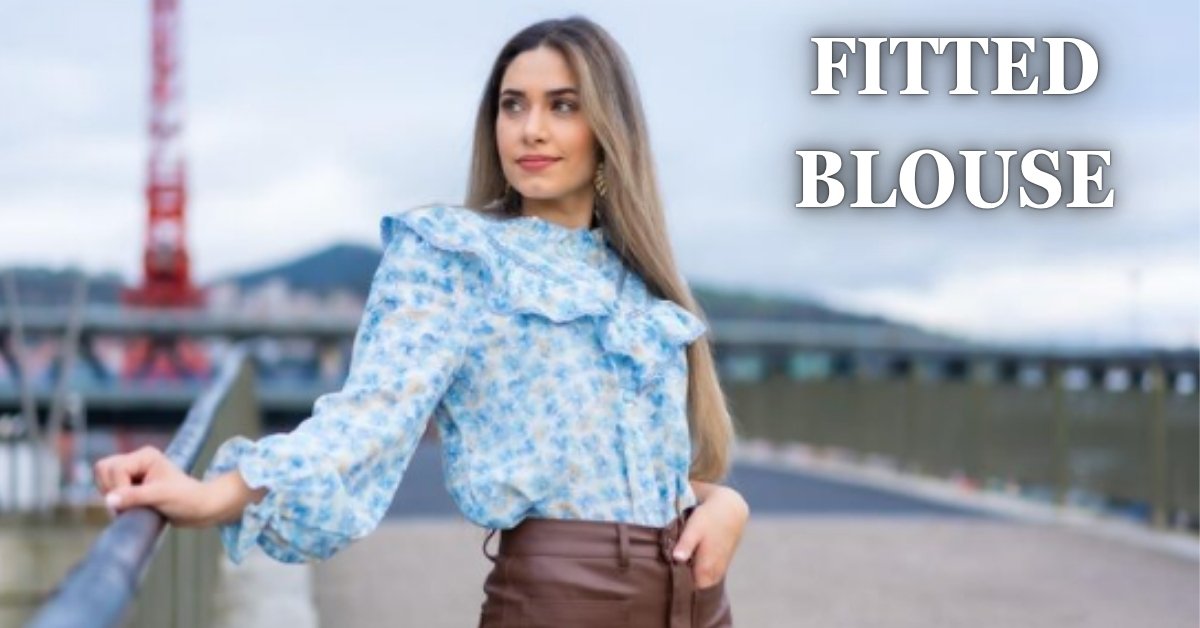
A fitted blouse either sits close through the bust and waist without pulling anywhere, or it doesn’t, and the difference almost never comes down to size alone. Most shoppers judge fit by how a blouse looks in the mirror standing still, then wonder why it gapes the second they sit down or reach for something. A fitted blouse is built with shaping seams and dart placement designed to follow a specific bust point, and when that point doesn’t match your own, no amount of sizing up or down fixes it. This guide covers what actually makes a blouse read as fitted, the one check that catches a bad fit before you buy, and how to style it once you’ve got the right one.
In Short
A fitted blouse relies on darts or princess seams to shape close to the body, and the real test isn’t the size on the tag. Button the top three buttons and reach both arms forward. If a gap opens at the bust, the blouse isn’t cut for your shape, regardless of how well it fits everywhere else.
What Actually Makes a Blouse Read as “Fitted”
A blouse becomes fitted through construction, not fabric stretch. Princess seams, the curved vertical seams that run from shoulder or armhole down through the waist, are what let a blouse follow the body’s shape without a single horizontal dart. Darting does similar work from a different angle, taking in small triangular folds of fabric at the bust and waist so the flat fabric wraps a three-dimensional shape.
Plenty of tops labeled “fitted” skip both and rely on stretch fabric instead, which is a shortcut that works fine for knit tops but rarely holds up in a woven blouse. A woven fitted blouse without shaping seams will pull straight across the bust and bag out at the waist, since there’s nothing built in to follow the curve. If you’re comparing two blouses and one has visible waist seaming while the other is a straight rectangle with a hem, the seamed one is doing the actual work.
The Fit Test Almost No Guide Mentions
Most styling advice treats “fitted” as a size question, try a size down, try a smaller cut, and stops there. That misses the actual failure point, which sits at the bust button, not the overall size. A blouse can measure correctly across the chest and still pull open between two buttons the second your arms move forward or you sit down, a problem called gaposis in sewing circles and it has nothing to do with being too small.
Gaposis happens when the button placement sits slightly outside the bust point rather than directly over it, so the fabric strains sideways instead of lying flat. It shows up on people of every size and cup shape, which is exactly why so many well-fitting blouses still gap at that one spot. The fix before buying is simple: button the blouse fully, then reach both arms straight out in front of you the way you would to type or drive. If a gap opens at the bust with your arms forward, that’s the blouse’s actual fit, not the flattering version you see standing still and relaxed.
A blouse that passes that test with the top three buttons closed will usually hold its line through a full day of sitting, reaching, and moving. One that fails it can sometimes be saved after purchase with a hidden snap sewn between the strained buttons, a fix tailors use often enough that it’s a standard request rather than an unusual one. But catching it in the fitting room costs nothing, while catching it after the tags are off means living with tape or a camisole underneath every time you wear it.
Fabric Choice Changes How “Fitted” Actually Looks
The same fitted pattern behaves completely differently depending on what it’s cut from, and this is where a lot of otherwise well-made blouses go wrong. A crisp cotton poplin holds a fitted shape with almost no cling, which is why it’s the standard for tailored, office-ready blouses that need to look sharp by 5 p.m. Silk and silk-adjacent fabrics do something different, following the body more closely and showing every seam and dart line underneath, so a fitted silk blouse needs slightly cleaner construction to look intentional rather than tight.
Crepe de chine in particular works well for a fitted cut because its slightly pebbled, matte finish hides the small wrinkles that a glossier weave like charmeuse would show off. That distinction matters more for a fitted silhouette than a loose one, since a fitted blouse has more fabric in direct contact with the body and less room to hide a stiff or clingy weave, a detail covered in more depth in this guide to reading silk momme weight before buying. A mid-weight momme, roughly 16 to 19, tends to give a fitted silk blouse enough body to hold its shape without turning sheer under normal indoor lighting.
Cotton-linen blends split the difference, offering more structure than pure silk with more breathability than poplin, though they wrinkle faster and need a quick press before wear if the fit is meant to read polished rather than rumpled.
Shoulder, Sleeve, and Length: The Checks Beyond the Bust
Once the bust passes the arms-forward test, three more spots decide whether a fitted blouse actually reads as well-fitted rather than just tight. The shoulder seam should sit right at the edge of your natural shoulder, not partway down your arm and not pulled up toward your neck. A shoulder seam that sits even half an inch off in either direction throws off how the whole sleeve hangs, no matter how well the waist and bust fit.
Sleeve fit matters just as much on a fitted blouse as body fit does, since a tight torso paired with a baggy sleeve reads as mismatched rather than intentional. Raise your arm to shoulder height and check that the sleeve doesn’t ride up your forearm or bunch at the elbow. For length, a fitted blouse generally works best ending right at or slightly below the hip bone if it’s meant to be worn untucked, since anything shorter starts to look like it shrunk in the wash rather than being styled that way on purpose.
Styling a Fitted Blouse Without It Looking Stiff
A fitted blouse reads most polished when it’s balanced against something with more volume below it, so the outfit doesn’t turn into one uniform silhouette. Wide-leg trousers or a fuller midi skirt let the fitted top do its job without the whole look feeling constrained, while a fitted blouse over equally fitted bottoms can start to feel like a costume rather than an outfit. Half-tucking works well here too, since it breaks up the line at the waist and keeps the fitted shape from looking too formal for a casual setting.
Layering changes the equation slightly. A fitted blouse under a structured blazer wants full tucking so the jacket’s lines stay clean, while the same blouse worn alone with jeans looks better loosely tucked or knotted at the front. For a smaller frame, a fitted blouse with visible waist seaming can actually add the illusion of shape rather than flattening it, a principle that shows up in fit advice across other pieces too, including how proportion changes what actually works on a petite frame.
Color and print play a role too. A fitted blouse in a solid, structured fabric photographs and wears more formally than the same cut in a soft floral or abstract print, so matching the fabric’s pattern to the occasion matters as much as matching the cut.
Conclusion
A fitted blouse earns its name from the seams and darts doing real shaping work, not from a smaller size number on the tag. Run the arms-forward test before you buy, check the shoulder seam and sleeve length, and match the fabric to how much cling you actually want against the body. Do that once and the next fitted blouse you pick will hold its shape through an actual day, not just a few seconds in front of a fitting room mirror.
FAQ
What is a fitted blouse supposed to look like?
A fitted blouse should follow the body’s natural line through the bust and waist without pulling or bunching, using darts or princess seams rather than just a smaller overall size to create that shape.
Why does my blouse gap at the buttons even though it fits everywhere else?
That’s gaposis, caused by the button sitting slightly off from your actual bust point rather than the blouse being too small, and it can happen at any size or cup shape.
What fabric holds a fitted blouse’s shape best?
Crisp cotton poplin holds structure with the least cling, while a mid-weight crepe silk around 16 to 19 momme gives a fitted silhouette body without turning sheer.
Should a fitted blouse be tucked in or worn out?
A fitted blouse generally looks most intentional tucked in or half-tucked, since a fully untucked fitted cut can bunch at the hip and lose the shape it was built for.
Can a fitted blouse be altered to fit better?
Yes, a tailor can add a hidden snap at a gaping bust point or take in the waist seam, both common, low-cost fixes that don’t require replacing the blouse.